

Smart business owners and marketers know that it’s challenging to instantly convert a prospect into a customer.
Creating a great customer experience and persuading someone to buy from you takes time, strategy, and a foundation of trust.
Lifecycle email marketing can help you grow your business faster.
What is lifecycle email marketing?
Lifecycle email marketing involves building a strategy that identifies the series of small steps a customer takes when buying your products or services and sending emails to prospects at critical stages of a customer journey to help them take the next step towards a purchase.

The email campaigns guide your leads throughout the different stages of their customer journey: from being unaware of your business to becoming loyal customers.
This guide will share insights on building robust and successful lifecycle email campaigns.
Although the general stages of a customer’s journey might differ from company to company, most companies have the following six stages:
- Awareness. The awareness stage is when target customers first come across your brand. It’s essential during this stage that you present a strong brand identity for your business to avoid creating friction and confusion.
- Engagement. People start their interaction with your brand during the engagement stage of the customer lifecycle. At this point, they want to learn about your value proposition and offerings. This stage can happen by opting to subscribe to an email list, following you on social media, or scrolling through your website.
- Evaluation. This is the decision-making stage. For businesses and marketers, this is the time to provide attractive and rewarding touchpoints that will make it easy for people to choose your brand. You can provide your prospects with information to help them decide, such as comparative information on product features, pricing, and your brand’s unique value proposition.
- Purchase. Congratulations, you’ve made a sale. At this stage of the lifecycle, the person is no longer a prospect. They are now a customer. Your objective is no longer focused on promoting your brand. Instead, this is the point where you ensure that the purchase process is smooth and as seamless as possible.
- Support. The post-purchase stage of the customer lifecycle is essential as this is where most people drop off after the initial purchase. To preempt this, you need to ensure that you are meeting your customers’ needs. Proactively communicate with them, i.e., confirming receipt of their order, informing them of the status of their order, and asking them about their experience. The support stage is about following up to receive feedback and ensure people are satisfied with the buying experience and, more importantly, your product or service.
- Loyalty. The loyalty stage happens when customers have consistent positive conversion and fulfillment experiences. Customers who reach this stage are often so happy with the product and your customer service that they’re delighted to let everyone know about their positive experience with your brand. At this point, you want to nurture their advocacy. It’s necessary to retain them as repeat customers who will eventually help bring in new buyers.
5 Components of a lifecycle email campaign
Having identified the general stages of a customer’s lifecycle, you can apply these principles to create your lifecycle email marketing campaigns.
Lifecycle email marketing involves sending a series of emails following a trigger – an action or a component – taken by a subscriber or prospect within every stage.
The behavioral trigger
This component is based on a pattern of customer behaviors. Some of the most prevalent behavioral triggers are:
- when a prospect signs up to be an email subscriber.
- when a prospect browses your product page.
- when a prospect abandons their cart.
- when a prospect purchases a product.
- when a prospect cancels their subscription.
Other triggers also include when a customer hasn’t reordered or bought anything for a certain period of time, when a subscriber has failed to open emails you send them in a few months, or when a customer opts in and registers for your loyalty program.
The waiting period
This refers to a period of time you set up between the triggering action and sending the first triggered email.
The number of emails
Each lifecycle email campaign consists of a predetermined number of emails.
There is no set rule about how many emails a specific journey type should have. The number of emails depends on the customer behavior and your brand.
However, some journeys work better as a more extended sequence than others.
For example, welcoming a new subscriber is different from reminding customers about their abandoned cart.
For the former, you might want to send out several emails that introduce your brand, products, or services, offer a discount count for their first purchase, and then send another email to invite them to your membership rewards program.
For the latter, it might make sense only to send one or two emails reminding a subscriber about their abandoned cart.
Email content and copy
This fourth component is the visual elements of every email you send out. This refers to the subject lines, images, design, links, and copy.
Offers
This component refers to the incentives and rewards you offer the subscriber, designed to spur them to take action. This can be promotions such as timed flash sales, special discount codes, free shipping, a reward or a gift, contests, etc.
Five lifecycle email campaigns every business should create
1. Welcome series
Goal: Convert a new subscriber into a customer.
When sending your “Welcome Series” email, you are already at the engagement stage of the customer lifecycle. That means that you communicate to prospects who have already progressed from knowing about your brand to actively engaging with it.
The Welcome Series is triggered by a form fill submission on your website. This stage is a significant milestone in developing good engagement because of the recency of the sign-up action.
Typically, a welcome series should educate new sign-ups about your brand, products or services, and mission. Welcome emails also usually include a welcome gift, such as a discount.
Best practices:
- Trigger the initial email to be sent within 5 minutes of a prospect customer signing up.
- Personalize the welcome message. If possible, mention the new subscriber by name in the subject line.
- Talk about your company briefly: your history, if it has a relatable and compelling story, or perhaps discusses the company ethos and mission.
- Include an attractive limited-time discount to convert new subscribers immediately. It is typical to see 15-25% off within these email flows. If discounts are not possible, consider offering free shipping for their first order.
- Throughout this journey, keep to a cohesive email design theme (through colors and fonts).
2. Cart abandonment campaigns
Goal: Guide customers in the conversion stage to finish the process and move their orders from cart to checkout.
There is a lot to be done with abandoned carts, and the cart abandonment series should be considered a high-value moneymaker. Be sure you leverage marketing psychology to build effective cart abandonment campaigns.
Cart abandonment emails are triggered by already known users who have entered the conversion stage but failed to complete the purchase for some reason or another. So they’re already shown some willingness to buy from you.
There are no rules for the waiting period, but you may opt to send the first cart abandonment email as soon as 30 minutes after abandonment. Other follow-up emails can be sent within 1 to 24 hours after abandonment.
Best practices:
- Be creative in illustrating the abandoned product/s in the email.
- Include similar products or category navigation within the email.
- Include a 10-15% off discount, but not until email #2.
- Remove users from the flow who have completed a purchase.
3. Browse abandonment emails
Goal: Retarget undecided customers and incentivize them to return to your site and make a purchase.
Few businesses and marketers realize the potential of browsing abandonment emails.
However, like cart abandonment, a browse abandonment series serves to activate and progress a known user from the engagement stage into the conversion stage.
This email series is triggered when the user browses products on your website but leaves without adding anything to their cart.
Browse abandonment journeys are typically less successful than cart abandonment series because most browsing customers aren’t necessarily ready to buy. However, they’re an essential component of your lifecycle email marketing campaign because you are still keeping in touch with your prospective customers by sending this series.
In industry practice, the first email in a browse abandonment series is usually triggered to be sent out within 1 to 24 hours after the shopper has left the website.
Best practices:
- Set up a maximum of 3 emails that you will send over a short period (i.e., 2-5 days from action taken on-site).
- Use the principles of excellent email design to showcase the products viewed by the customer creatively. If possible, use the product photos as the main image.
- Include a prompt for additional product recommendations or other purchase categories.
- Add a 10-15% off discount, but not until email #2.
- Remove users who have completed a purchase.
- Exclude users from the flow if they went back to browsing and left items in their cart. By then, you can transfer them to a cart abandonment flow.
Take inspiration from how Adidas’ carefully crafted their browse abandonment email.
They lead with a non-intimidating subject line of “Thank you for dropping by!”
It’s encouraging but not pushy and salesy. It leads to showing appreciation for the customer.
The email then stylishly displays the sneaker that the shopper was viewing before leaving the website and follows this up with a discount offer should they decide to return to the site and buy it.
Notice the addition of the neon yellow section of the email. It is a clever use of color to draw the eyes of the customer towards the discount offer.
Also, note how Adidas is adding suggestions of a few other sneakers that the customer might be interested in. This is a subtle show of personalization and conveys to the customer how attuned Adidas is to their customer’s preferences.
Lastly, the email ends with a mention and a final push with a brief reminder of the perks of shopping online.
4. Purchase sequences
Goal: Provide a pleasant and seamless order fulfillment experience that will remind customers of the ease of doing business with your brand.
Purchase sequence emails are not substantial revenue drivers. However, these email flows are essential to your customer’s optimal post-purchase experience.
Purchase journey emails contain all the essential details for the customer that will contribute to a better customer experience that could lead to a higher customer lifetime value.
This journey includes emails such as the order confirmation or a purchase receipt, shipping confirmation, delivery confirmation, and, if applicable, a follow-up review request.
Designing a cohesive, on-brand look and feel for this email sequence is essential. Think of this email flow as an indirect advertisement of your business’ customer service.
The consistent design serves as visual cues for the customer to associate the pleasant customer experience with your brand.
Best practices:
- Set up your purchase emails to be sent out to all buyers, regardless of their email subscription status.
- If possible, proactively include a “Track my package” call-to-action early in the email. This is an added service to provide the customers easy access to keep tabs on their order status.
- Include all the pertinent and essential order information in this email flow.
Take Fitbit’s order confirmation email as an excellent example of a purchase sequence email.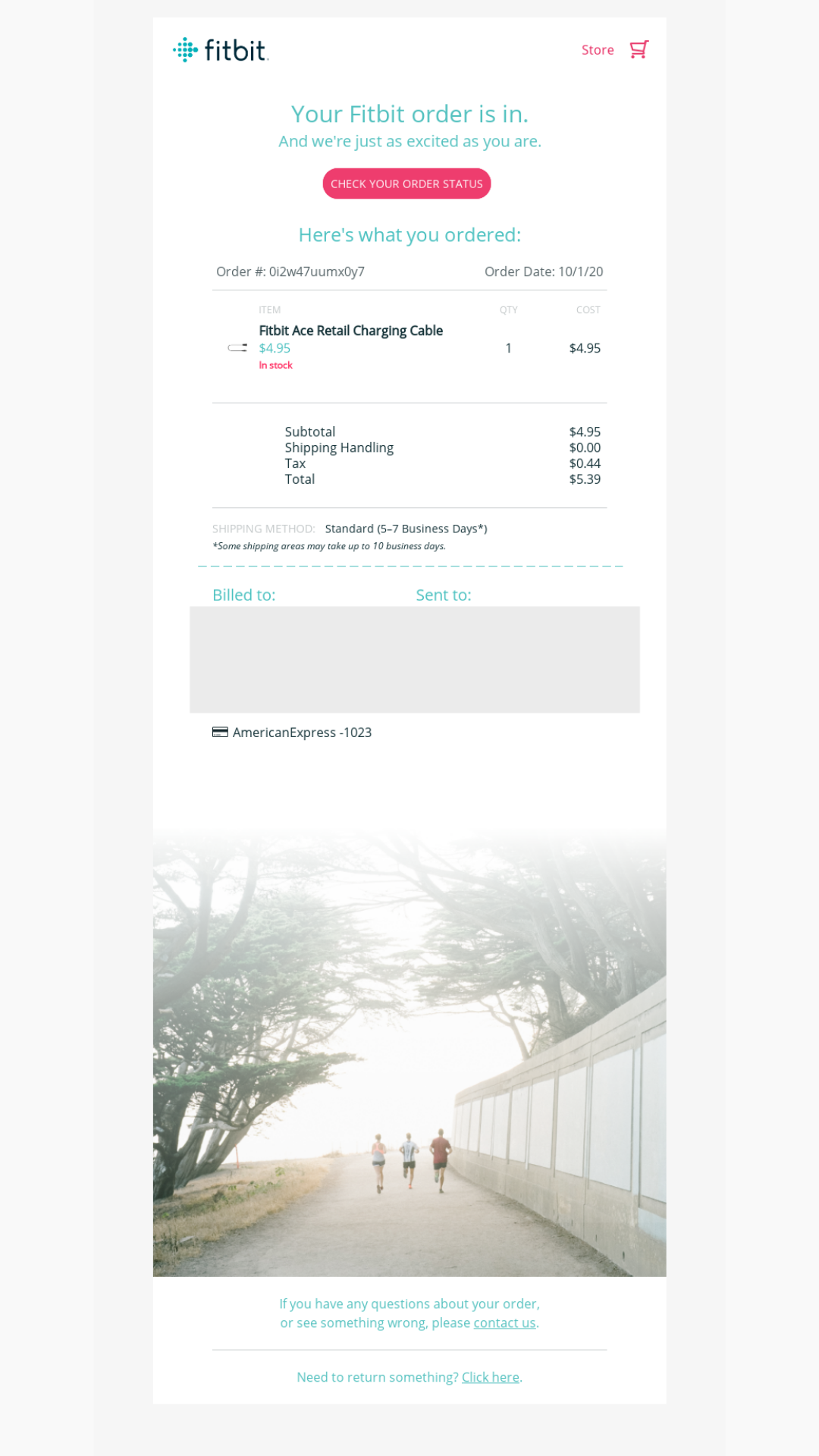
Its design is clean and straightforward. However, while simple in layout, it still features critical brand elements such as the brand’s font and color scheme.
A pink “check your order status” button at the top of the email shows that the company prioritizes the customer’s concern to track their order.
The rest of the email body includes all the relevant information regarding the customer’s order:
- the order number and date
- the product they bought
- the price of the product,
- the price breakdown of the order (including free shipping and tax)
Fitbit also lists the estimated shipping time, where the product will be sent, which address it will be billed to, and how it was paid for.
This email is also great at preempting their customers’ needs by including a “Contact Us” link at the bottom of the email.
This shows the brand’s willingness to attend to customer concerns.
5. Winback emails
Goal: Activate dormant customers so they can make a new purchase.
Winback emails are most popular among subscription-based D2C brands. However, they can also be helpful for many e-commerce businesses.
For this flow, you deal with customers who have run through most of the customer lifecycle.
They’ve gone through the awareness, engagement, conversion, and fulfillment stages but have fallen short of transitioning towards the loyalty stage.
A win-back campaign is aimed at first reactivating them to enter the engagement stage and then bringing these customers back to the conversion stage.
A second goal is to eventually lead them into becoming repurchasers who will turn into loyal customers later on.
Winback campaigns are typically triggered by a set number of days since the customer’s last purchase date.
Best practices:
- Decide how long you should wait before sending a win-back series.
- Use data collected on your customers’ typical repeat purchase behavior as the basis of your win-back series trigger. This can differ depending on the brand and the nature of the business. For example, eCommerce brands maybe are comfortable with a six-month wait period. But subscription brands might not want to wait that long.
- Use this email to coincide with new product launches or updated categories.
- Include a discount.

This win-back email by Moosejaw uses a killer combination of an aspirational hero image, a sweet discount, and a personable, casual tone that coincides with their brand voice.
The highlighting of the discount code in red in the email body stands out. Moreover, it is cleverly positioned at the tail end of the email so that the customer has to scroll through all the content from top to bottom.
Lastly, the email adds links to the store. This makes it easy for the customer to resume shopping again.
Now that you know more about lifecycle email marketing, it’s time to create lifecycle campaigns to help you grow your business faster.
We regularly update this lifecycle email marketing guide. We most recently updated this guide on May 23, 2022.
Interested in other types of businesses or how-to guides? Here are our comprehensive guides:
How to Start a Business: The Complete Step-by-Step Guide to Starting a Business in 2022
How to Write a Business Plan (2022)
Branding: The Definitive Guide for 2022
The Definitive Guide to Successfully Rebranding in 2022
What is Brand Identity? And How to Create a Unique and Memorable One in 2022
The Ultimate Small Business Guide to Brand Equity in 2022
The Complete Guide on How to Name a Business
Brand Strategy 101: How to Create an Effective Branding Strategy [GUIDE]
The Definitive Content Marketing Guide
Social Media Marketing: The Ultimate Small Business Guide for 2022
Small Business Guide to Lifecycle Email Marketing: How To Grow Your Business Faster
The Ultimate Guide to Using Twitter for Business in 2022
YouTube Marketing: The Complete Small Business Guide 2022
Instagram Marketing: The Ultimate Small Business Guide for 2022
How to Use LinkedIn: The Ultimate Small Business Marketing Guide
The Ultimate Small Business Guide to Marketing on TikTok
Public Relations Guide for Small Business (7 Proven PR Tactics)
How to Start a Consulting Business in 2022: The Complete Step-by-Step Guide
How to Start a Real Estate Business in 2022: Complete Step-by-Step Guide
How to Start a Trucking Business in 2022: The Complete Guide
How to Start a Property Management Company
How to Start a Successful Online T-Shirt Business in 2022: The Definitive Guide
How to Start an eCommerce Business: A Step-by-Step Guide To Take Your Business Online (2022)
Nonprofit Branding: Complete Guide to Building a Strong Nonprofit Brand in 2022
How to Start a Cleaning Business in 2022: The Complete Guide
6 Businesses You Can Start For Less Than $1,000
Marketing Psychology: What You Must Know To Supercharge Your Marketing
What is a DBA and How to File One For Your Business
How to Start a Clothing Line or Clothing Brand From Scratch in 2022: The Definitive Guide
How to Start a Brewery Business in 2022: The Complete 9 Step Guide
How to Start a Medical Marijuana Dispensary Business in 2022
How to Start an Etsy Shop: Your Comprehensive, No-Stress Guide to Starting an Etsy Shop in 2022
How to Start a Photography Business in 2022: The Complete Step-by-Step Guide
How to Start a Business in Texas: The Complete Step-by-Step Guide (2022)
The Definitive Guide to Creating a Compelling Visual Brand for Your Restaurant in 2022
Conversion Rate Optimization (CRO) Guide: How to Make Your Website Work Smarter (2022)
Facebook Messenger Chatbot Marketing: The Definitive Guide (2022)
Branding for Food Trucks: The Definitive Guide (2022)
