
This is not a twinning moment.
Marketing and advertising, although related, are very different from each other. Although both business activities strive to refine the brand image and increase sales, advertising is a subset of marketing and works toward different goals.
Technology such as marketing automation software and cross-channel advertising software automates marketing and ad campaigns to collect prospect information, create targeted campaigns, and report performance. Effective marketing and advertising activities help businesses reach higher conversions and lead generation, as well as manage customer relationships.
Marketing vs. advertising
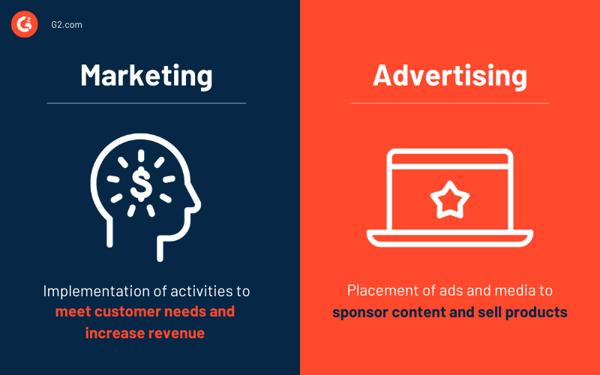
Marketing requires exploring, creating, and delivering value to meet customer needs while maximizing revenue. Advertising is a part of marketing communication that includes sponsored messages to sell products, services, concepts, or ideas.
Although we hear people talk about marketing and advertising interchangeably, it’s important to remember that the latter is a part of the greater marketing umbrella. So yes, they are entirely different processes but are related and can be grouped together. Like cousins, ya know?
What is marketing?
Everyone raise your hands for your favorite corporate buzzword!
While a majority of people have no problem explaining what marketing encompasses, it can get a little winding to define it to the point. So let’s do a little refresh.
Marketing is defined as any business practice that helps identify and predict customer demands while creating and delivering product or service value. Successful marketing requires researching target audiences, market conditions, and product opportunities.
The process lies at the heart of effective product development and guides a company’s value propositions and selling points. It is therefore not wrong to say that marketing has a big impact on a business’s bottom line.
Benefits of marketing
Marketing is like a jack of all trades – it can do many different things for businesses based on their specific needs. All sectors employ marketing strategies in one way or another (print, digital, face-to-face, door-to-door) to grow their customer base, promote goods, and increase revenue.
Brand reputation
One of the biggest facets of marketing is capturing audience attention. Most marketing strategies work to create a memorable experience for the customer to maintain top-of-mind awareness. This helps develop a brand reputation, one that is tied to quality, value delivery, and customer satisfaction.
Paying attention to the direct and indirect experiences customer have with a company is directly linked to reputation management. Businesses around the world have now understood the importance of a brand’s public perception and how it affects revenue.
Revenue sources
In an ideal world, all businesses understand the importance of aligning sales and marketing efforts to increase the number of available revenue options. While sales are and should be the priority of any company, revenue collected through marketing activities increases profits primarily by targeting customers based on their preferences and purchase histories.
Marketers strive to boost revenue strategically through promotions, campaigns, business messaging, and price reduction. By working closely with sales, marketing teams directly attribute to lead generation, conversion, and retention to achieve shared business goals.
Customer engagement
I’ve said this once and I’ll say it again: businesses that focus on customer engagement are the ones that are winning.
When it comes to customer engagement, marketing helps refine customer communication by keeping the conversation relevant. Investing in engaging customers promotes products while providing consumers with important information and a sense of belonging.
Customer engagement forms part of the overall customer experience and is essential to ensure that customers know what the company is and why they should buy their products or services.
Sales
When users have the information they need to make a purchase decision, they feel more confident to take the leap and convert.
Leveraging the principles of marketing is a sure-shot way of making customers feel like they understand the benefits of buying a product or service. Simply put, the more informed customers are, the more likely they are to convert and consequently, boost company sales.
Goal distribution
Every business works toward specific goals and objectives. Goal setting is most often the first step in creating plans, teams, and workflows.
Having dedicated marketing strategies in place leads to a clear identification of what targets the marketing team should achieve. These include increasing brand awareness, maintaining reputation, reaching more customers, and contributing towards marketing business revenue.
How to develop a marketing strategy
Developing and implementing a successful marketing strategy looks different for different companies. The first step is identifying marketing goals and target audiences. Typically, this information is included in an organization’s business plan and guides the marketing objectives and activities.
Even though every business has its own way of formulating marketing strategies, there are a few elements that should be considered by all marketers.
Market orientation
A marketing strategy, like any business strategy, must be based on specific knowledge and research. It’s essential that marketers use this information to align their efforts with the company’s mission, vision, and culture.
Market orientation is key to understanding whether the business must orient its strategy towards the product, sales, or overall marketing activities. The various market orientation perspectives include market intelligence, decision-making perspective, strategic perspective, cultural and behavioral perspective, and customer orientation perspective.
Marketing environment
Any factor that can have an impact on a company’s marketing strategy should be considered as part of the marketing environment. This includes both micro and macro environments such as the operating country’s economic environment, the business’ competitive environment, the technological environment, as well as the political and social environment.
Market research
The difference between any ol’ business and a great one is the attention to detail it gives to market and user research. Focusing on the characteristics of a customer, building user personas, and studying different user segments helps to gauge which audiences will respond effectively.
Additionally, collecting geographic and demographic data of target customers makes it easier to market products and services.
Marketing mix
Any of you who have ever looked up the basics of marketing must be familiar with this concept.
The marketing mix serves as a decision-making tool for a company’s marketing strategy. It refers to the variables a business chooses to influence buyer response and behavior. These elements work together with other initiatives to establish a brand and sync with the marketing plan and advertising strategy.
Elements of the marketing mix
The seven Ps of marketing have retained their importance and relevance even with all the changes in the marketing world:
- Product
- Price
- Place
- Promotion
- People
- Process
- Physical evidence
The four Cs of marketing are a customer-centric alternative to the four Ps:
1. Consumer needs
2. Cost
3. Convenience
4. Communication
What is advertising?
I might regret this later, but take a minute away from reading this article and think back on the most memorable ad campaigns you can think of. I’ll go first: Open happiness by Coca-Cola!
Advertising is the process of making audiences aware of products and services by producing paid advertisements that contain brand messages. Advertising campaigns are intended to promote goods and establish a strong brand image to guarantee product recall and increase sales.
A key element of advertising is that it establishes a one-way communication channel to promote non-personal brand messages. Another factor that distinguishes advertising from marketing is that the content is completely controlled by companies.
Benefits of advertising
Successful advertising campaigns help consumers make rational purchase decisions and empower businesses to expand their market.
- Customer education: Teaching customers how to use and gain value from products guides consumers through their buying journey. When customers have more knowledge about a product, they make more informed decisions and learn more about the brand.
- Brand perception: Advertisements improve customers’ perception of the brand, and they can quite literally make or break its reputation. By creating credibility and customer loyalty, customers feel like they can trust the business and be part of their culture.
- Product introduction: Companies also leverage advertising techniques to introduce novel products or services to attract new customers and increase their customer base.
- Customer retention: Employing strategies like offering discounts, seasonal offers, and customized messaging to retain customers, increase return on investment, and ensure customer lifetime value.
Differences between marketing and advertising
If you’ve been following through (which I hope you have), you may have a better understanding of what marketing and advertising are as standalone concepts.
While marketing is a broader business activity and can directly affect an organization’s bottom line, advertising plays an integral role in brand positioning, product placement, and enticing new customers to increase sales.
Roles and responsibilities
Marketing and advertising have different business functions and goals even though the main, shared objective is making the business profitable.
Marketing is focused on five central activities.
- Trend analysis and competitor research: Marketers analyze the marketing environment, current industry topics, and competing campaigns. They must also know how to implement effective strategies and tools to acquire customers and improve customer engagement.
- Branding: A company’s brand is an outcome of how it communicates with customers, targets prospects, and interacts with various stakeholders.
- Relationship management: By leveraging surveys, interviews, and CRM software, marketing teams collect customer feedback to improve campaign quality to better meet their needs.
- Cross-collaboration: Marketers are responsible for ensuring different departments like sales and product development are aware of marketing goals and know how to support one another.
- Budgeting: Tracking ROI on campaigns is one of the most important functions of the marketing team. Budget tracking and forecasting based on past and current financial data help prevent overspending.
Advertising has a narrow focus and involves processes like:
- Pitching ad strategies: Advertising is a very creative field, and a large part of advertising work is developing ad strategies and plans to market the brand and its products.
- Customer analysis: Advertisers must present a concrete brand image and rationale behind every ad campaign so marketers can understand customers.
- Managing creative productions: Advertising is content-heavy. There are several ways to create ads, from video to podcasts to tv commercials. Advertising teams are responsible for researching ideas and managing the production of all types of ad campaigns.
- Purchasing media: Since ads are paid media, advertising teams must know which platforms to use for sponsoring content to deliver maximum business and brand value.
Techniques
Since marketing and advertising work toward achieving different goals, there is a difference in how they meet those objectives.
Remember the days when marketing referred to receiving product catalogs in your mail and being delighted at their arrival? The good ol’ days. Modern marketing strategies have evolved from humble print efforts into the digital and e-commerce era.
- Digital marketing: Another great buzzword. Leveraging marketing concepts across computers and mobile devices is called digital marketing. Search engine optimization (SEO), email marketing, website optimization, and content marketing are some digital marketing strategies.
- Social media marketing: Yes, I know you know what this is but let me say it anyway. Businesses that use social media such as Facebook, Twitter, Instagram, and TikTok (happy now?) engage with existing and potential customers. Influencer marketing, a subset of social media marketing, involves product promotion through popular social media users as part of earned media practices.
- Brand marketing: It’s not easy to maintain an online brand reputation. Businesses must invest time, effort, and money to ensure they are easy to recall when users think of a specific service. Brand marketing evaluates company assets, such as logs, overall design decisions, and product packaging. A strong brand value helps businesses understand the target market, beat competitors, and increase customer retention.
- Relationship marketing: Customers are the primary stakeholders of any company. Marketing campaigns centered around customer satisfaction form a large part of establishing relationships that create a loyal customer base.
An advertising campaign aims to spread brand awareness about the company and its products to acquire customers and generate more sales with product launches and promotions.
An advertising campaign must be tailored to business objectives, target audience, and customers’ wants and needs. Knowing where your customers are most likely to be exposed to ads is essential to campaign success.
- Traditional advertising: Print and broadcast media advertising are examples of conventional advertising. These include newspaper ads, television commercials, and radio advertisements.
- Digital advertising: This method places ads on the internet and other websites in contextual advertisements, banners, and sponsored content.
- Paid search: This advertising technique involves keyword bidding to appear in pay-per-click (PPC) ads in search engine result pages (SERP). PPC ads drive website traffic when clicked.
- Social media advertising: Ads that are promoted via social media platforms get real-time engagement and quick ROI. Brands that leverage social media advertising software for their ad campaigns often have an interactive way to engage with users due to the nature of the platforms.
- Mobile advertising: Automated dialers, app download banners, and click-to-call (CTC) ads are part of mobile advertising. This type of advertising is carried out on mobile devices and smartphones.
- Retail advertising: A very common type of advertising, ads in retail stores are placed to maximize product sales. These can include product displays, ads on carts, or featured items within the retail space.
- Outdoor advertising: This involves placing ads on physical structures such as billboards, buildings, or branded vehicles. Such ads are usually placed near areas with heavy foot and automobile traffic to capture attention.
Metrics of success
Every business activity is dependent on decided analytics and measurements. Implementing marketing analytics tools simplifies and optimizes overall marketing strategies to ensure long-term success.
Marketing metrics
The five main metrics to measure against campaigns for marketing teams are:
- Net promoter score: A single survey question to understand whether users would recommend a company product to another person
- Customer satisfaction: A measure of how a company or service meets the expectations of its customers
- Market share: The percentage of the total sales a business makes in its market
- Business revenue: The total income of an organization
- Customer lifetime value: The total worth of a customer to a company during the business relationship
The five key metrics to use as a guiding force for advertisers are ad reach and impressions, return on ad spend, engagement, and conversion rates.
Advertising metrics
Five essential metrics to measure the success of advertising campaigns:
- Reach: The total number of people who view the ad content
- Impressions: The total number of times the ad is displayed
- Return on ad spend (ROAS): The revenue generated from an ad campaign
- Engagement: A measure of how customers react cognitively, emotionally, and physically to an advertisement
- Conversion rate: The total number of conversions divided by the total number of ad interactions
Similarities between marketing and advertising
As is evident by now, advertising is essentially a part of marketing activities.
While marketing prepares a product for the market, advertising is responsible for increasing product visibility within the marketplace.
Marketing involves several stakeholders and is a broad business function, while advertising has a narrower focus and works on producing effective communications. They leverage data and research collected by marketers to promote the brand through creative and compelling messages.
Know the difference to make a difference
Marketing and advertising are integral organizational functions. Collectively, they can improve customer satisfaction, target new prospects, and strengthen brand value.
Regardless of the type of campaign employed, it’s important to research and have the necessary information about both activities to maximize their business impact.
Understanding marketing and advertising is a great step toward improving the overall customer experience management process. Learn more about the importance of customer experience and its impact.