
Image source: Getty Images
A marketing plan serves as a key component of a business plan. It identifies the target markets and customers for your company’s products or services as well as how to successfully sell to that audience.
While a marketing plan contains the same core ingredients across companies, small businesses face unique challenges. When it comes to a marketing plan for small business, two key factors are at play: limited resources and tight budgets.
To give a sense of scale, a tight budget for a multinational corporation may amount to a few million dollars. For a small business, the marketing budget may be a hundred dollars a month or less.
Consequently, the kind of comprehensive marketing plans employed by large corporations simply won’t work for small businesses. The differing dynamics necessitate a separate approach, which we’ll cover here.
How to design a marketing plan for your small business
A set of six key steps form the core of every marketing plan, regardless of company size. These components can appear overwhelming for a small business, especially given resource and budget constraints.
That’s why every small business should leverage software to create and execute a marketing plan. For instance, one of the more popular marketing channels is email marketing. The steps involved in this tactic alone can consume a significant portion of your resources without the help of email marketing software.
That said, limited budgets may preclude some small businesses from investigating a software option. Fortunately, free software solutions exist, such as Zoho Campaigns.
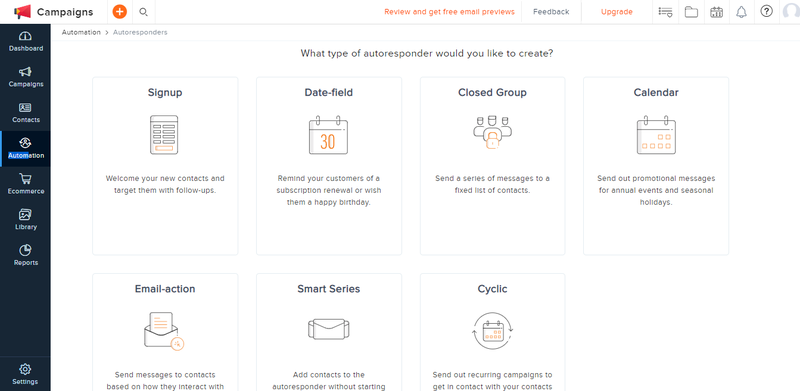
Zoho Campaigns provides many features in a clean user interface. Image source: Author
So, as we walk through the steps to build your marketing plan outline, keep in mind that software is available to support your marketing plan.
Step 1: Define your goals
Before diving into planning your marketing efforts, take time to clarify what you’re trying to achieve. By setting goals, you focus the limited time, resources, and budget at the disposal of your small business on the activities that move you toward your objectives.
Best practices for defining goals:
Defining your marketing goals can be challenging. Here are some tips to help.
- Measurable goals: Establish goals that are measurable to track progress. A natural approach is to use revenue, but an example of a measurable goal is not simply, “increase revenue by 10%.” Certainly, every business wants revenue growth, but the real question is how. For instance, you may be trying to increase revenue by acquiring customers in a new market. In this case, the goal is execution of a market development growth strategy. Associated metrics can include the number of customers acquired in the new market, increases in market share, or month-over-month sales growth.
- Goal alignment: The marketing goals should align with the overall objectives of the company. If not, the marketing team will be at odds with other leaders in the organization.
- Stakeholder buy-in: To ensure alignment between marketing and other areas of the business, identify the relevant stakeholders and get their buy-in on the marketing goals. These stakeholders include the leader of the sales team, the CEO, CFO, or others affected by the marketing plan.
- KPI identification: Create key performance indicators (KPIs) to measure the march toward your goals, but make sure you’re focusing on the appropriate KPIs. For instance, picking too many metrics can become overwhelming. Consider which ones relate directly to your goals, and zero in on the ones most impactful to the business. If your goal is to increase website traffic by 20%, KPIs to monitor should include the sources of that traffic, specifically which sources are consistently the largest contributors.
Step 2: Perform research
A marketing plan’s success depends on two things:
- Deep knowledge of your target customers so you can find the right audience for your company’s offerings and employ the appropriate marketing tactics to reach that audience.
- An understanding of the target market, including market size, revenue potential, and competition.
Perform research to acquire the necessary knowledge for each area.
Research methods include leveraging third-party reports and industry news, conducting customer interviews, calling local competitors to collect insights, and performing data analysis using available data about your customers. Third-party research and data can be expensive, so look for low-cost or free sources online.
Best practices for research:
Even if you feel like your company has a good grasp of your customers and the market, use research to confirm internal understandings.
- Buyer personas: Identify the characteristics that define the ideal customer for your product or service. To that end, build a buyer persona, a profile that documents these characteristics, for each market segment you’re pursuing. The buyer persona allows everyone in the company to be on the same page regarding your target customers, and it aligns marketing strategies with what works for your clients. For example, the buyer persona helps determine if you’ll use a push vs. pull marketing approach. If your data leave gaps in the buyer persona, that’s your indicator that more research is required.
- Market definition: The market research piece, like customer research, requires an understanding of the characteristics of the market or industry you’re targeting. Pay particular attention to the market dynamics at play. For instance, when Dollar Shave Club took on industry giant Gillette in the razor business, no razor manufacturer sold directly to consumers (only to retailers), so Dollar Shave Club took advantage of this market dynamic to sell direct online and take market share away from a much larger competitor.
- Data analysis: Marketing plans are data-driven, but collecting and analyzing the requisite data can prove onerous. CRM software facilitates this exercise. If your business employs a CRM, use it to segment your customers and perform other analytics to inform your plan, such as market sizing. If you’re not using a CRM, this data collection and analysis will take time. One alternative is to obtain stakeholder input on financial models or market sizing.
- Customer segmentation: Part of the research phase includes learning how to segment your customers. Customer segmentation is a worthwhile exercise because you can align your marketing tactics based on each customer segment. HubSpot CRM can perform this segmentation work for you, but if you lack a CRM, you may need to segment by broad buckets such as customer age, income level, or geographic location. Then plan to adopt free software to begin a deeper data collection and analysis phase at a later date.
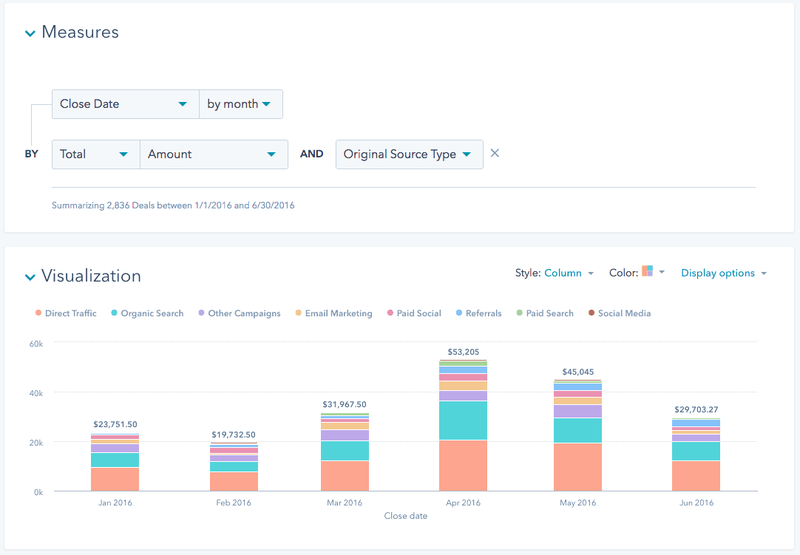
HubSpot’s CRM delivers insights to improve your marketing strategy. Image source: Author
Step 3: Address the principles of marketing
Every marketing plan involves the four principles of marketing: product, price, place, and promotion. Together, these four Ps form the strategy a business uses to sell its products and services.
Product refers to any offering provided by a business to generate revenue. Price is the amount charged for the product. Place refers to how customers can buy the product. Promotion describes the marketing activities used to sell the product.
If you don’t address each of these four Ps, a marketing plan is meaningless. For example, before selling a new product, a business must determine how much to charge, how customers can buy it (such as through its website), and how best to promote it based on the research performed in step two.
Document the specifics around the four principles in the marketing plan. And finally, determine an approach to test and validate your company’s strategies.
Best practices for applying the marketing principles:
Here are some tips to put the marketing principles in play.
- Product: You may have a sense for how the company’s offerings solve customer problems or needs, but to validate these impressions, identify early adopters of your products or services who can later become case studies for your marketing collateral.
- Price: Another area to validate with early adopters is product pricing. Is your pricing strategy the right one? Find out by offering your company’s solutions for a discount, or even for a free trial period, then collect feedback on the value delivered. The more value perceived by customers, the more you can charge.
- Place: Make it easy for customers to acquire your offerings to increase the likelihood of a sale. You can test this with your early adopter group as well. Once they’ve tried the product, you can interview them or provide a survey that allows them to deliver feedback on their purchase experience.
- Promotion: You can test this, too, by spending small amounts on different promotional tactics and measuring the efficacy of each. Then ramp up spending on the ones where results proved encouraging.
Step 4: Establish the positioning strategy
Your company’s positioning strategy unifies the business message to customers. It defines the look and tone of all of your marketing collateral, and it outlines how sales and marketing articulate your company’s offerings to clients.
As such, you must determine your company’s positioning before building and executing a marketing plan.
Many small businesses skip this step because it seems like overkill, but if you don’t establish your positioning proactively, your customers will do it for you. How do you want customers to perceive your business? Now is the time to take control of that.
Best practices for creating the positioning strategy:
Because positioning is difficult to change in the minds of customers, take time to figure out what you want your brand and company’s offerings to convey before your positioning solidifies. To do so, follow these tips.
- Company mission: Examine your company values and mission statement. Is your company about being a low-price leader, an innovator in sports medicine, or the most customer-centric business in the world? Start there, and begin to construct a personality around the company’s mission and vision for use in positioning.
- Competitors: Look at how competitors position themselves in the market. Think about how you’d like to differentiate your business from them.
- Positioning validation: Try out the new positioning statement with a handful of customers, such as your early adopter group, to collect feedback and refine it.
Step 5: Build the plan
The plan itself is a comprehensive document outlining the marketing or advertising tasks requiring completion to reach your goals within a specific time frame, as well as the associated costs to manage budget constraints.
The plan also includes details about your marketing mix and positioning. It delineates the specific tactics, like direct marketing, you plan to utilize based on buyer personas and customer segmentation.
Best practices for building the marketing plan:
At this stage, you’re combining elements of the previous four steps into a cohesive whole. This then serves as your roadmap to achieve your plan goals. Here are some suggestions to get you there.
- Budgets and timing: Before creating a marketing plan, first determine your budget and timeframe. If you’re launching a new product on a specific date, your marketing plan must revolve around that date. Also, defining your budget in advance allows you to know what kinds of marketing tactics you can afford to employ.
- Marketing tactics: A wide array of compelling digital marketing tips exist, so it’s common for a marketing team to want more included in the plan than reasonably possible with small business resources. So, make the difficult decision of narrowing the options to only those that will move you toward your immediate goals. For example, if you’re launching a new product, customer outreach activities such as online advertising should be the priority, not establishing a loyalty program.
- Software support: Build your plan in a software solution such as monday.com. Software streamlines the entire process of managing your plan, so you can spend precious time on plan execution rather than manual updates to a project document.
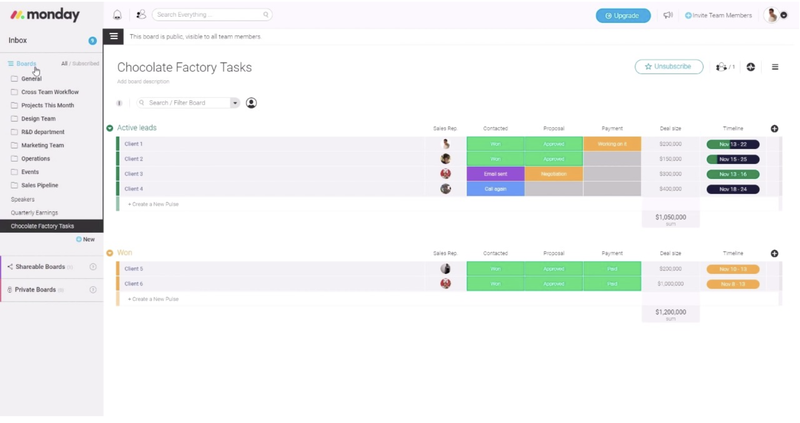
Project management software such as monday.com makes it easy to set up and track marketing plans. Image source: Author
Step 6: Adjust the plan
Even with a carefully considered plan, you don’t know how well it will perform until you execute it. So, be prepared to make adjustments based on the measurable KPIs you outlined.
Best practices for adjusting the plan:
Because marketing is a data-driven profession, as you collect more data from executing your plan, it makes sense that the new data insights will reveal the need for adjustments. Here’s how to implement a process of continuous improvement.
- Slack insertion: Build slack into your plan to accommodate changes. That way, when it requires adjustments, you won’t struggle against time constraints.
- Expectation setting: Set expectations upfront — with stakeholders and the team executing the marketing plan — that the plan will be fine-tuned along the way. Also, schedule regular check-in meetings with the team to address challenges and keep everyone on the same page with changes.
- Data insights: If you lack data to inform your marketing plan at the start, prepare to revisit the plan once you collect the necessary data to make more informed decisions.
Final advice about marketing plans for small businesses
Larger companies employ a sales analysis, expense analysis, market share analysis, financial analysis…you get the picture.
Since small businesses don’t have this luxury, sometimes you have to make educated estimates to arrive at a decision. That’s perfectly acceptable as long as you learn from your mistakes and are willing to continually improve your plan. This iterative process of learning and refining is the nature of small business marketing strategy.